Role
Lead + Designer
Team
2 (me + manager)
Platforms
Web | Landing Page (partial)
Focus
AI-powered reading


Lead designer — embedded in the product, delivering weekly.
I owned the web reader end-to-end — designing, presenting, and iterating daily based on client feedback. I was the client-facing designer on the project: translating PRD requirements into design decisions and representing the work directly to stakeholders.
My focus was the reading experience itself: how the layout shifts between modes, how menus surface and disappear, how the AI companion integrates without competing with the book.
01
Designed the dynamic layout system
Split-screen vs. focused reading with persistent background modes
02
Defined sleek menu interaction
Defined menu placement and behavior for translation, summarization, and workbook features
03
Gamified Onboarding
Redesigned the onboarding from a flat questionnaire into a gamified experience with a Reader Clarity Score
04
Landing Page Contribution
Contributed to sections of the landing page alongside my manager


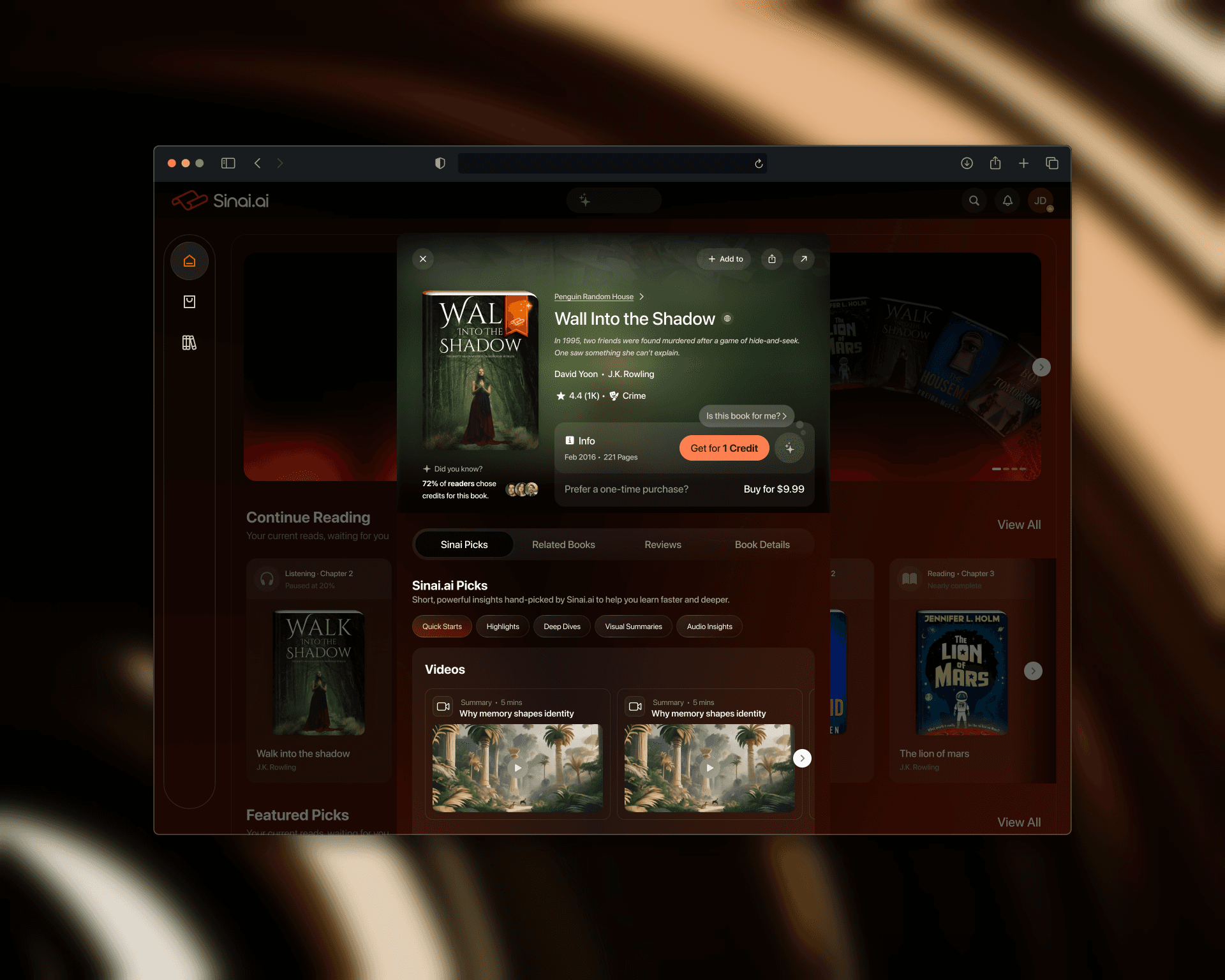
The book is always the hero
Apple Books was a key reference — not for its features, but for its restraint. The interface disappears. Every design decision was tested against one question: does this compete with the book?
Modes that coexist, not compete. Audio and the AI companion don't replace each other. The layout either splits the screen or keeps both running quietly in the background. The reader decides how present the tools are — the interface never decides for them.

One reader. Every mode.
The web reader was designed around a single principle: the experience should flex around the reader, not the other way around. Whether you're deep in a chapter, listening while away from the screen, or running an open-book exam session with the AI — the interface adapts without announcing itself.
01
Dynamic layout Split-screen or focused — the reader decides. Both modes stay active in the background regardless of what's visible on screen.
02
Surface, don't bury Menus for translation, summarization, and navigation appear where they're needed, when they're needed. Nothing is more than one gesture away. Nothing gets in the way unprompted.
03
Companion, not chatbot The AI companion lives inside the reading experience — not beside it. It reads with you, answers questions, summarizes chapters, and runs exam sessions, all without pulling you out of the book.
04
The original onboarding was a questionnaire. We turned it into a discovery. Three core questions build your Reader Clarity Score — the more you answer, the clearer your reading persona gets. A gentle sticky nudge lets you complete questions one at a time, on your own terms. No pressure, no drop-off.

From feature list to feeling.
The client's words, not mine: the investor reviewing the product said it felt like sitting in front of a fireplace — present, warm, and unobtrusive. That's the benchmark for a reading product that works.
The platform launched with a reading experience that handled everything the PRD asked for, without the reader ever feeling the complexity underneath.