Arabic writing, elevated.

Arabic writing, elevated.

Arabic writing, elevated.

An AI-powered writing assistant built for Arabic, correcting grammar, restructuring thoughts, and adapting tone across four platforms without disrupting how you already work.

An AI-powered writing assistant built for Arabic, correcting grammar, restructuring thoughts, and adapting tone across four platforms without disrupting how you already work.

Role

Lead + Designer

Team

3 designers (led 2)

Platforms

Landing Page | Web | Desktop | Extension

Focus

Arabic-first AI writing

lisan.ai

Our task was to design Lisan.ai in a way that makes Arabic writing clear and confident. Since most users were already relying on tools that don't fully support Arabic, the experience had to clearly show what the product does, how to start correcting and refining writing, and how to do it without leaving the tools they already use.

Our task was to design Lisan.ai in a way that makes Arabic writing clear and confident. Since most users were already relying on tools that don't fully support Arabic, the experience had to clearly show what the product does, how to start correcting and refining writing, and how to do it without leaving the tools they already use.

Challenges

Challenges

Three tensions, one product.

Three tensions, one product.

Feature Richness vs. Simplicity

The client wanted many features, but wanted the UI to feel simple and focused. These two demands were in constant tension.

Cross-Platform Consistency

Four platforms, three designers, one experience. Consistency couldn't rely on luck, it needed a system.

Decision made

Arabic-first meant every UX pattern, interaction model, and layout assumption had to be reconsidered, not just mirrored.

My Role

My Role

My Role

Lead designer | hands on and directing simultaneously.

I led a team of two designers (one on web, one on desktop) while personally owning the landing page (responsive/mobile) and the expert review phase. This wasn't a hand-off structure, I was producing and directing in parallel.

01

Expert review — before touching anything

I audited the existing product state myself, identifying experience gaps and interaction inconsistencies before the team began competitive research. This gave us a baseline to measure against.

02

Structured competitive analysis

I divided competitors across the team with specific focus areas — not "look at everything," but targeted questions. I took Grammarly and Notion as my own, given their direct relevance to the mental model I was building.

03

Insights review with the client

Once research converged, I presented findings and got a green flag on the direction before any design began. No wasted work.

04

Parallel execution with structured check-ins

I assigned each designer their platform with clearly defined tasks and expected flows. Weekly group reviews kept everyone aware of what the others were building — so inconsistencies surfaced early, not at handoff.

Key Design Decisions

Key Design Decisions

Familiar, not copied.
Grammarly is already embedded in how Arabic professionals write — they use it at work, even if it doesn't serve Arabic well. Building something that felt completely foreign would create friction where familiarity could be an asset.

Option considered

Build a completely original interaction model that differentiates from Grammarly

Decision made

Ground the experience in familiar patterns, differentiate through Arabic-specific depth and tone controls

Notion informed the editor
clean action menus, surfaced only when relevant, never overwhelming. The client wanted simplicity Notion proved you could have power without noise.

Option considered

Build a completely original interaction model that differentiates from Grammarly

Decision made

Ground the experience in familiar patterns, differentiate through Arabic-specific depth and tone controls

Solution

Solution

Solution

One experience, four entry points.
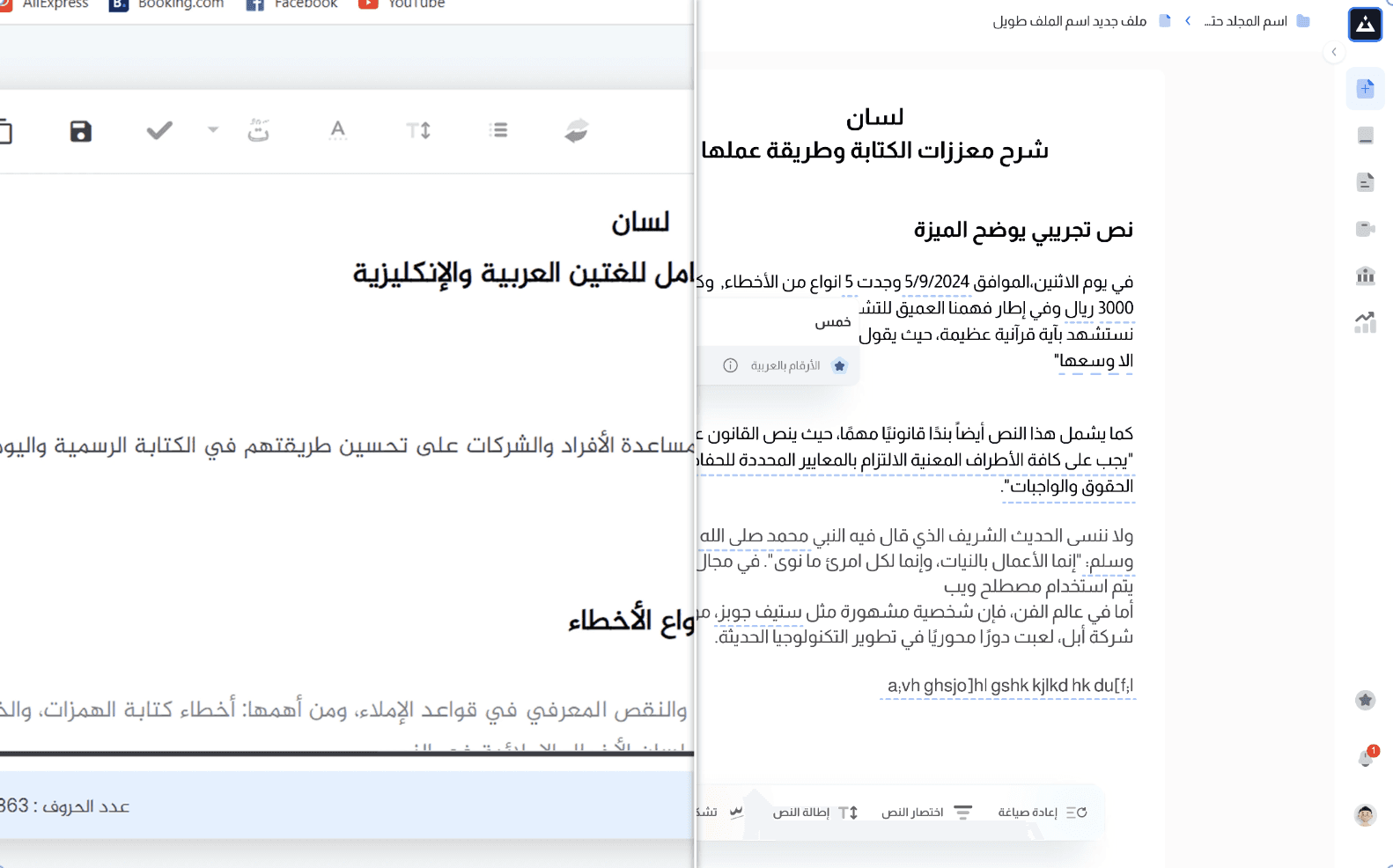
Rather than building four separate products, we defined a shared interaction logic first, then adapted it per platform. Every correction behavior, tone selector, and suggestion pattern had to feel native to all four contexts.

01

Landing Page

The entry point. Where users explore more about Lisan.ai

02

Browser extension

Corrects inline wherever you write — no tab switching, no friction

03

Web editor (SaaS)

Full writing environment with real-time AI support

04

Desktop app

Import files, work daily — for power users who live in the product

Outcome

Outcome

Outcome

The client saw something they didn't expect. The feedback was clear: the team delivered an experience that moved the product somewhere the client hadn't imagined when they started. That's the metric that matters when the product is still finding its footing.
Challenges

Three tensions, one product.

Feature Richness vs. Simplicity

The client wanted many features, but wanted the UI to feel simple and focused. These two demands were in constant tension.

Cross-Platform Consistency

Four platforms, three designers, one experience. Consistency couldn't rely on luck, it needed a system.

Decision made

Arabic-first meant every UX pattern, interaction model, and layout assumption had to be reconsidered, not just mirrored.

Let's build exceptional designs together

© All rights reserved 2026.

Let's build exceptional designs together

© All rights reserved 2026.

Let's build exceptional designs together

© All rights reserved 2026.

Create a free website with Framer, the website builder loved by startups, designers and agencies.