Safer communities, one report at a time.

Safer communities, one report at a time.

Safer communities, one report at a time.

A redesigned civic reporting app for Saudi Arabia's Ministry of Interior — rebuilt with behavioral psychology, gamification, and a social feed to turn passive citizens into active community contributors.

A redesigned civic reporting app for Saudi Arabia's Ministry of Interior — rebuilt with behavioral psychology, gamification, and a social feed to turn passive citizens into active community contributors.

Role

Co-led with 1 lead · 3 designer

Team

Tremoloo

Platforms

Mobile App

Focus

Civic safety platform

Our task was to redesign an app that existed but nobody used. The reporting experience was confusing, the motivation to report was absent, and the interface felt like a form — not a civic tool. We rebuilt it around the question nobody had asked: why would someone actually report?

Our task was to redesign an app that existed but nobody used. The reporting experience was confusing, the motivation to report was absent, and the interface felt like a form — not a civic tool. We rebuilt it around the question nobody had asked: why would someone actually report?

Challenges

Challenges

An app for the public. Built without asking why anyone would use it.

An app for the public. Built without asking why anyone would use it.

No reason to report

The original app had no incentive structure. Citizens could report violations, but there was nothing in it for them. Without a motivating reason, most people didn't bother. The app existed. The behavior didn't.

Incentives that could be abused

Adding financial rewards solved one problem and created another — false reports submitted for the reward. The system needed to distinguish between high-stakes violations worth financial incentives and others better served by recognition-based rewards.

A reporting flow that felt like a government form

The submission experience was a long form — slow, unfamiliar, and unsuited to the moments when someone actually wants to report something. The interaction model needed to change.

My Role

My Role

My Role

I co-led the project alongside another lead — owning UX direction, client communication, and reviewing and designing with a team of three.

01

Expert review
Audited the existing app and identified the core experience and motivation gaps

02

Behavioral workshop (Saudi Arabia)
Facilitated an on-ground workshop with relevant stakeholders to surface what features matter most and prioritize them

03

Gamification strategy
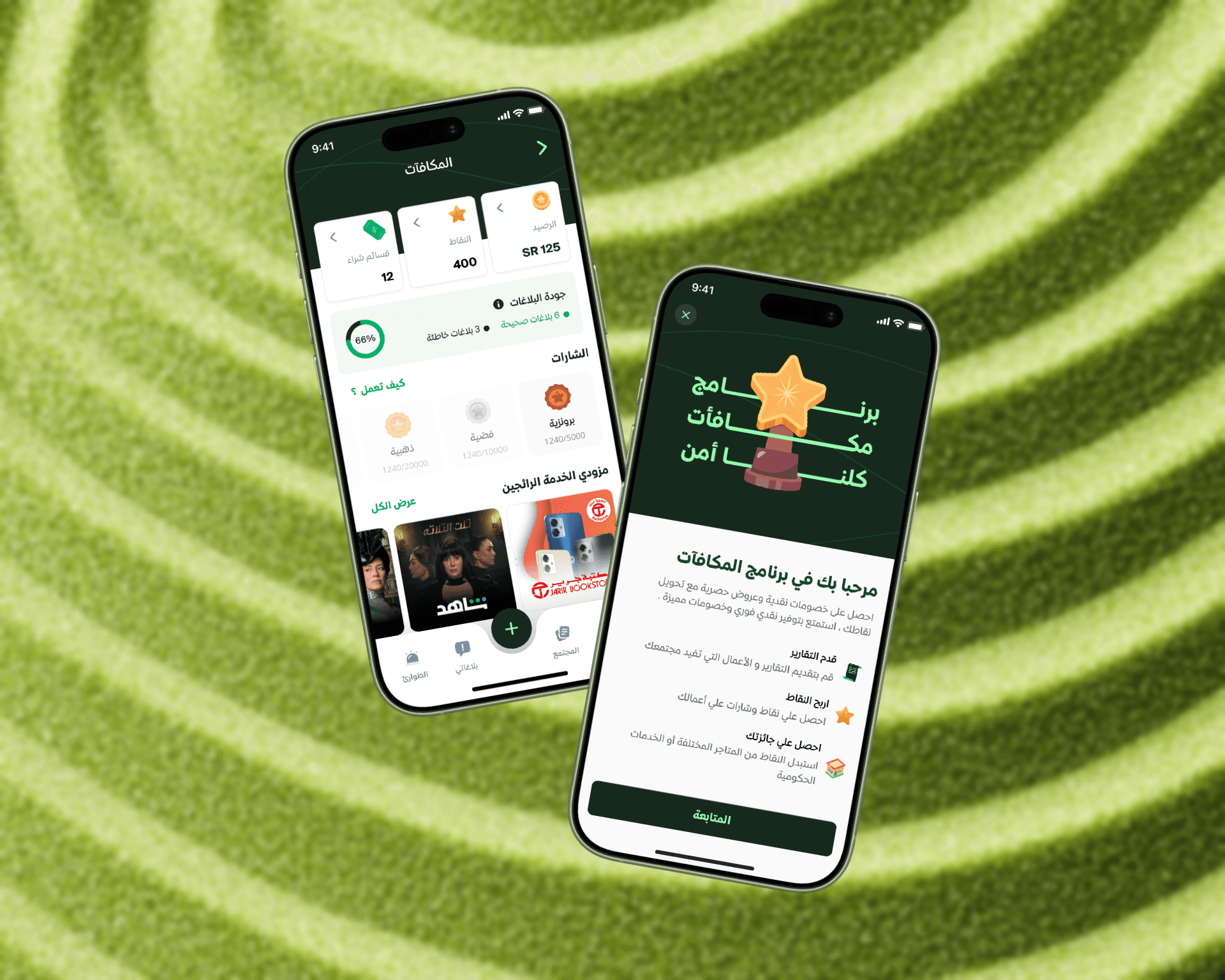
Designed the incentive architecture: financial rewards for specific violation types, badge and ranking systems for others

04

Reporting flow
Redesigned the submission experience around Snapchat's interaction model — fast, familiar, minimal steps

Key Design Decisions

Key Design Decisions

Start with why — behavioral psychology before interface. Before a single screen was designed, we ran a behavioral workshop in Saudi Arabia with the people who matter. Using the Octalysis gamification & Hooked Model framework, we identified two core drives that would motivate reporting: Epic Meaning (contributing to community safety) and Incentives (tangible rewards). The interface came after the behavior model, not before.

Option considered

Add gamification as a feature layer on the existing app

Decision made

Rebuild the motivation architecture first — define what drives reporting, then design around it

Rewards that can't be gamed. Financial incentives for every report type would invite false reporting and flood the verification team. We worked with the Ministry of Interior to define a specific list of violation types eligible for financial rewards. Everything else — when verified — earns badges and community ranking. The reward matches the risk of abuse.

Report like you post on Snapchat. Research showed Snapchat is one of the most-used apps in Saudi Arabia. We designed the reporting flow around that familiar interaction: tap the central + button, capture, submit — in the fewest steps possible. No long forms for situations that demand speed.

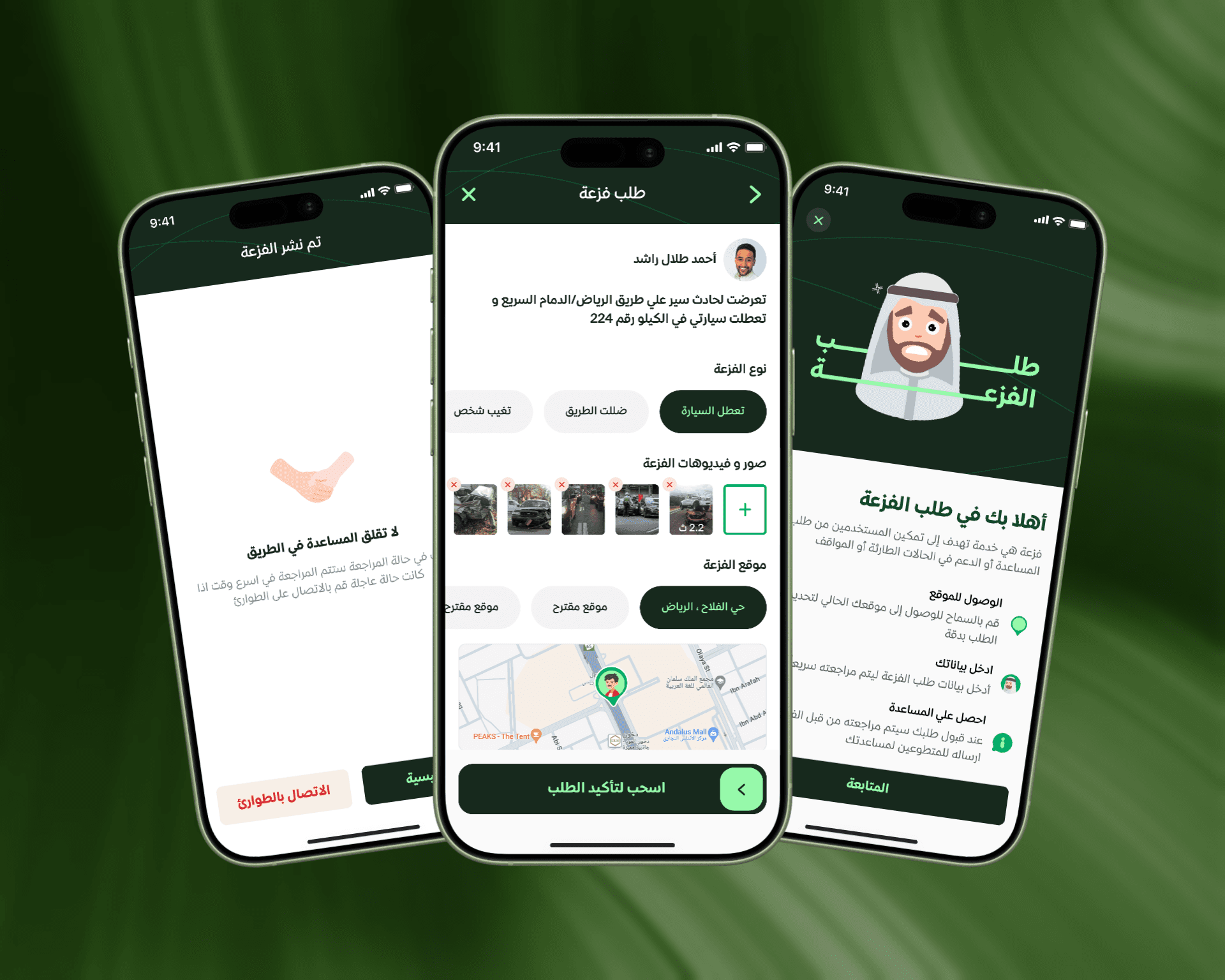
Faz'aa — community help, safely. The faz'aa feature lets anyone in need broadcast a help request to nearby users. The responder's verified identity is shared with the requester before they arrive — name, profile, ETA. Community help without compromising safety.

Al-Mujaz — a feed worth opening. A location-aware feed with official posts from government entities, short-form stories, safety tips, and community volunteer opportunities. Not just a reporting app — a reason to open it daily.
Option considered

Add gamification as a feature layer on the existing app

Decision made

Rebuild the motivation architecture first — define what drives reporting, then design around it

Solution

Solution

Solution

Report. Earn. Contribute.

01

Redesigned reporting flow Snapchat-inspired submission — central + button, fast capture, minimal steps. Citizens can report a violation in the time it takes to send a message. The long form is still available for complex reports. The quick flow is the default.

02

Gamification & incentives Financial rewards for Ministry-approved violation types. Badges, community rankings, and recognition for everything else. False reporting doesn't pay — verified reporting does.

03

Faz'aa A geolocated community help broadcast. Nearby users receive the request, verified responders share their identity before arriving. Help that feels safe on both sides.

04

Al-Mujaz feed Location-aware official news, entity stories, safety tips, and volunteer activities — all in one feed. The app becomes a daily civic companion, not just a reporting tool.
Outcome

Outcome

Outcome

From unused app to civic platform.
A government safety app rebuilt from the behavioral layer up — with a motivation model grounded in psychology, a reporting flow modeled on the apps people already love, and a community feed that gives citizens a reason to return. The Ministry of Interior shaped the incentive rules. We shaped the experience around them.

Challenges

An app for the public. Built without asking why anyone would use it.

No reason to report

The original app had no incentive structure. Citizens could report violations, but there was nothing in it for them. Without a motivating reason, most people didn't bother. The app existed. The behavior didn't.

Incentives that could be abused

Adding financial rewards solved one problem and created another — false reports submitted for the reward. The system needed to distinguish between high-stakes violations worth financial incentives and others better served by recognition-based rewards.

A reporting flow that felt like a government form

The submission experience was a long form — slow, unfamiliar, and unsuited to the moments when someone actually wants to report something. The interaction model needed to change.

Let's build exceptional designs together

© All rights reserved 2026.

Let's build exceptional designs together

© All rights reserved 2026.

Let's build exceptional designs together

© All rights reserved 2026.

Create a free website with Framer, the website builder loved by startups, designers and agencies.